
Staging Planned in Advance
Where material sits, how it reaches the surface, and the order of work are settled before the day, because an alley gives no space to reorganize.
Serving Pittsburgh, Pennsylvania & surrounding areas
Mon–Fri 8am–6pm · Sat 9am–2pm
Many Dormont homes park at the rear, reached by an alley rather than the street. A surface approached that way is staged differently, because there is nowhere to turn and little room to work.

A rear driveway off an alley is reached through a corridor built for one vehicle. Material and equipment have to come in that way and leave the same way, so the work is sequenced from the far end outward with no opportunity to turn around.
There is also less room beside the surface than a street-facing driveway has. Garages, fences, and neighboring property sit right at the edge, so staging has to be worked out before the crew arrives rather than improvised in the alley.
Add in the shade these spots usually get and you have a surface that needs more drying time and a tighter plan than its square footage suggests.
Dormont is a short run from 2123 5th Ave, Suite 4, Pittsburgh, PA 15219, and the access check happens on the first visit so the staging is settled early. The broader scope of work appears under sealcoating in Pittsburgh.
Each of these comes back to the approach: a single-vehicle alley decides where material can be staged, how long the drying allowance runs, and when the drive reopens.
Where material sits, how it reaches the surface, and the order of work are settled before the day, because an alley gives no space to reorganize.
Coating runs from the furthest point back toward the alley so the crew is never stranded behind fresh sealer with no route out.
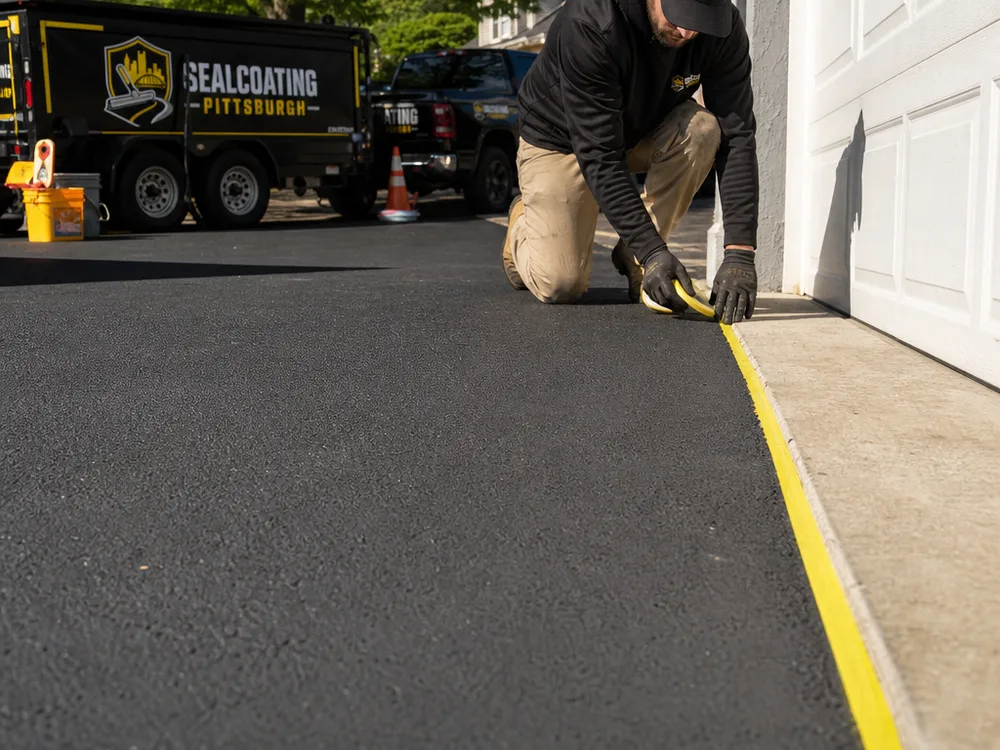
Garage thresholds, fence lines, and neighboring edges are masked first. At this clearance there is no margin for a stray pass.
Rear surfaces between buildings get limited direct sun, so cleaning and drying are given the time they genuinely need before any coat goes on.
Neighbors use that alley too. The plan covers how long any part of it is occupied and when your own surface is usable again.
The visit starts in the alley. How wide the approach is, what the turning situation really is, whether material can be brought to the surface without crossing a neighbor's ground, and where everything can be staged.
On the driveway itself the common findings are moisture-related: a surface shaded for most of the day holds damp, grows moss along the edges, and keeps grit packed where the garage meets the asphalt. The threshold at the garage door is usually the first place to show wear.
That gives us the staging plan, the realistic drying allowance, and the written scope, all confirmed before a date is agreed.
This covers rear residential driveways reached by alley. Alley-served commercial pavement raises delivery and dumpster access questions that we work through separately.
 Controlled edge application
Reaching the surface is the first problem and the one that shapes everything after it, including how long the drive stays closed.
The approach, the clearance, and the staging options are checked on foot before anything is scheduled, since those limits set the whole method.
Garage thresholds, posts, fences, and any neighboring surface within reach are covered before material is opened.
Moss, packed grit, and residue come off the shaded margins and the garage threshold, which is where sealer most often fails to bond.
The surface is given time to dry through rather than being coated on schedule. On a shaded rear driveway that is the difference between a coat that holds and one that lifts.
Material is applied working back toward the alley, so the finished surface is never crossed and the crew leaves without touching it.
Sealing a residential driveway in the Pittsburgh area usually comes in between about $250 and $900, set by size and condition. Smaller single-car surfaces are frequently $250 to $450, while longer runs, wider parking areas, and small private lots are commonly $500 to $900 or more.
A rear surface reached from an alley carries extra staging and handling time, which is labor rather than material. Threshold repair or patching at the garage line is scoped separately when it is needed. The final number follows a site visit, once the approach has been seen.
Book Your Free InspectionRear driveways and the thresholds where they meet the alley, which is where damp, debris, and the heaviest wheel traffic all tend to collect at once.
What people ask about work behind the house: access, alley disruption, and why a shaded rear surface behaves differently.
Usually, but the approach is checked first rather than assumed. The alley width and the staging options decide the method, and if access genuinely will not work we say so at the walkthrough.
Partly and briefly, for staging and material handling. How long and which portion is covered in the plan beforehand, since other households use that route as well.
Shade. A surface hemmed in by garages and fences sees direct sun for a small part of the day, so it stays damp, holds grit, and grows moss along the edges. All of that has to come off and dry before coating.
It is a common pattern. The threshold takes every vehicle entering and leaving, holds water running off the roof, and meets a concrete or block edge. It often needs repair before the surface is coated.
Longer than an open front driveway, because there is less sun and air movement. You get a reopening time based on the conditions on the day rather than a standard figure.
Only where the alley is part of the surface you own or are responsible for. Shared or municipal alley pavement is a separate question, and we will be clear about where the boundary sits.
If your rear driveway is staying damp, growing moss at the edges, or breaking up at the garage threshold, have the access and the drying conditions assessed before sealing is scheduled.
Call for a Free EstimateTell us how the surface is reached, how wide the alley approach is, and what the garage threshold looks like. We will check the access, allow for the drying conditions, and put the staging and scope in writing first.
Request a quote
Send the size, surface condition, and access details. We reply with next steps and schedule an on-site look before any written scope.